">
">
As part of Trumbull250, we are continuing our look at Revolutionary War veterans who later became some of the earliest settlers of the Western Reserve.
In Parts One and Two, we traced how these men carried the Revolution with them into new lives in Northeast Ohio. Part Three adds three more stories that still live on in local cemeteries and family memory.
Researchers estimate that roughly 200 Revolutionary War veterans settled in Trumbull County when counting the northern tier of Mahoning County, which remained part of Trumbull until 1846. By 1840, only 32 veterans were still living here, already becoming a fading generation.
Quick takeaways
- Part three follows three veterans who later connected to Bazetta, Vernon, and Johnston Townships.
- Their stories include everything from pioneer travel and church building to personal tragedy and quiet service.
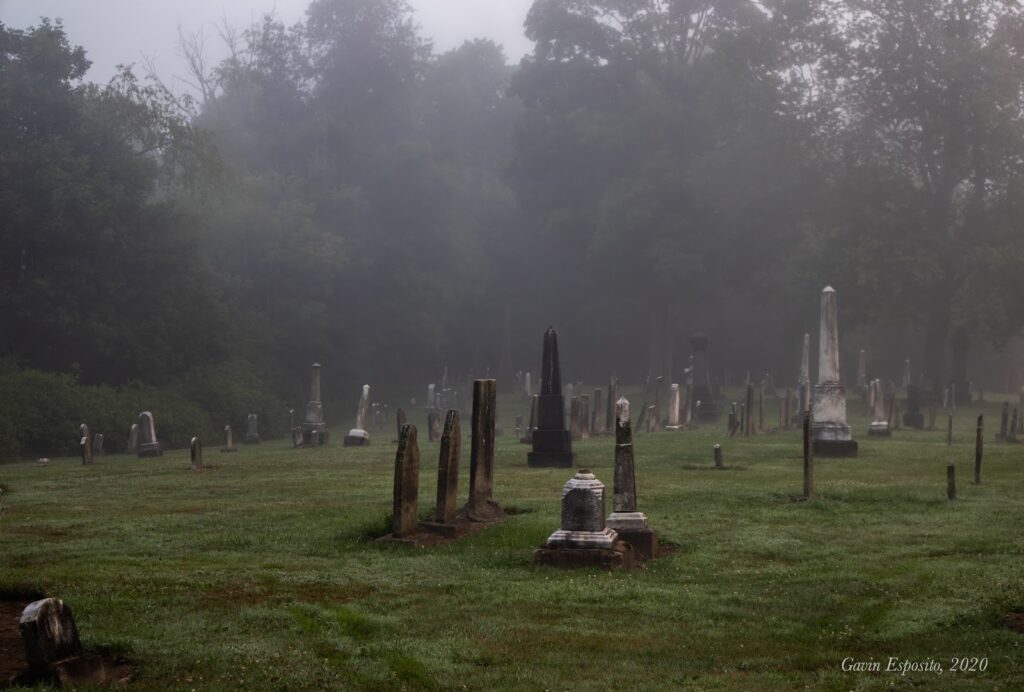
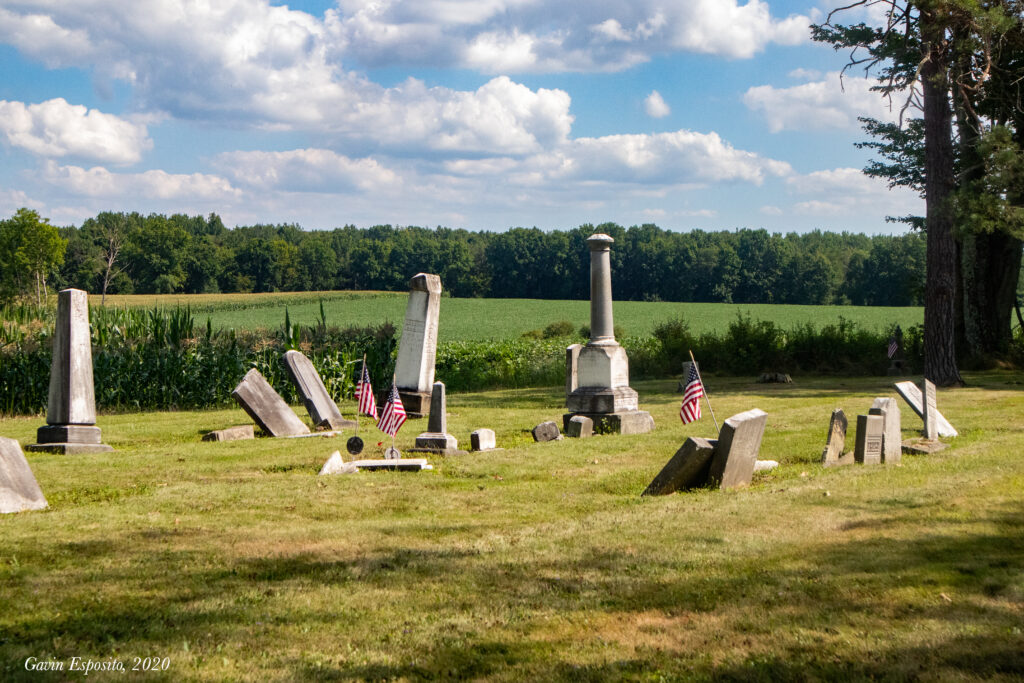
- Cemeteries referenced include Casterline Cemetery in Bazetta, Vernon Center Cemetery in Vernon, and Evergreen Cemetery in Johnston.
Edward Drake Dray, Bazetta Township (1741–1828)
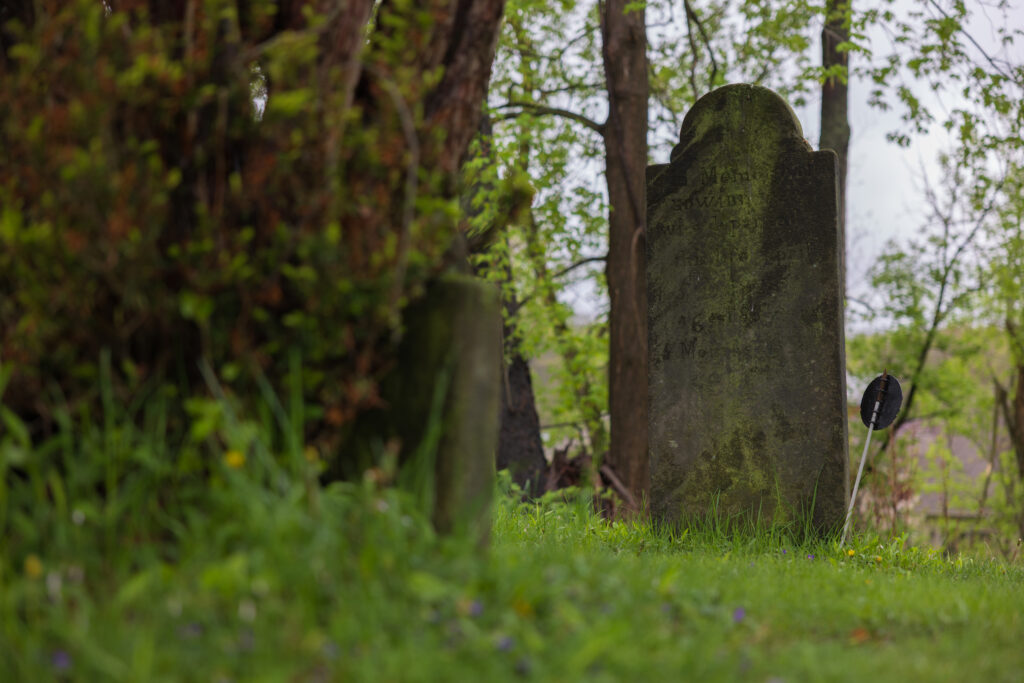
Edward Drake Dray’s life reads like a puzzle with missing pieces. Born November 3, 1741, he was the second of five children of Edward and Mary (Vail) Drake. Even his birthplace is uncertain, with sources pointing to County Antrim in Ireland, Pennsylvania, or New Jersey, though the evidence leans toward New Jersey. At some point, he began using the surname “Dray” instead of “Drake,” and no clear reason survives for why.
During his early adulthood he married Mary Agnes Agnew, a native of County Antrim, Ireland, though when and where the marriage took place remains unclear. By the mid-1770s the family was living in Cumberland County, Pennsylvania, where Edward enlisted as a private, first class, in the 6th Company, 5th Battalion of the Cumberland County Militia under Col. Arthur Buchanan. His recorded service is brief, including an active-duty tour under Capt. Alexander McCoy dated July 20, 1777, and he never applied for a pension, leaving many details lost.
By 1790, Edward is listed in Allegheny County, Pennsylvania, first in Versailles Township and later in Moon Township, where he remained until 1809, when his name appears on a tax list for Wethersfield Township in Trumbull County. After his wife died September 17, 1823, he moved to Bazetta Township and lived alone, his fourteen children having scattered.
In early 1828 he drafted a will dividing land among his sons. Only weeks later, in April 1828, Edward died by suicide. The Western Reserve Chronicle reported the death and noted that the cause behind the “melancholy event” was unknown to the publishers. Two years later, in January 1830, the will’s validity was contested in a three-day trial, during which testimony suggested Edward had made prior attempts and that there may have been improper influence surrounding his final decisions. Ultimately, the will was upheld.
Edward Drake Dray was buried in what is now Casterline Cemetery, deeded as a burying ground to Bazetta Township by Ziba Casterline in 1829. He rests beneath a simple mudstone marker with little ornamentation, with a veteran’s medallion indicating his service.
Obed Crosby, Vernon Township (1753–1813)
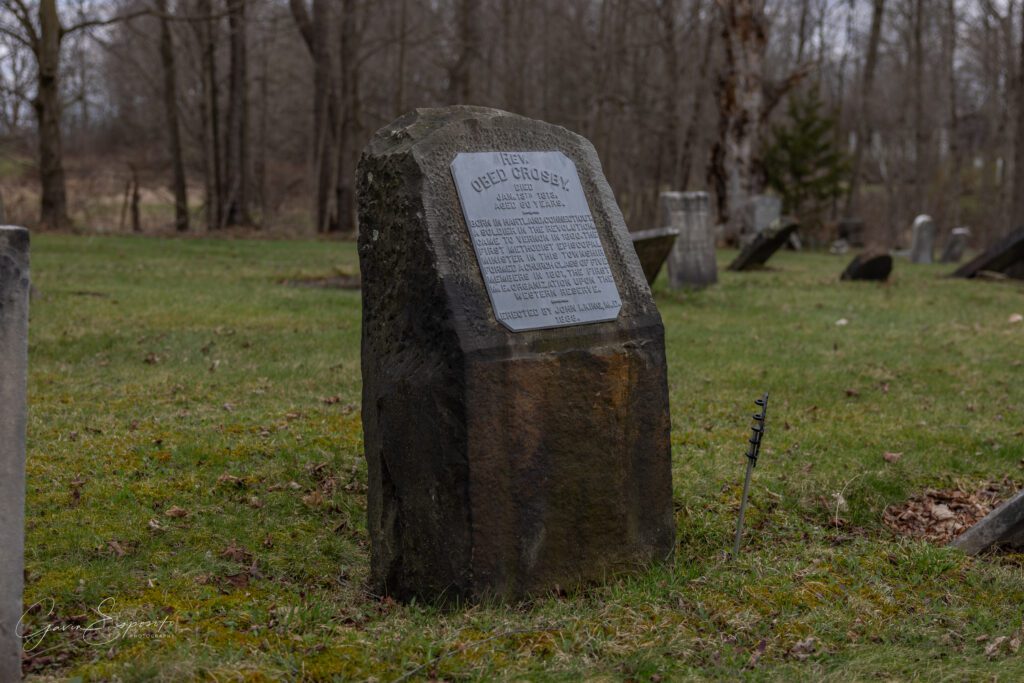
Obed Crosby was born July 22, 1753, in East Haddam, Connecticut, the fourth of nine children of Simeon and Lydia (Graves) Crosby. As a teenager he moved to Hartland, Connecticut, and in “the spring of 1776 or 1777” he enlisted as a non-commissioned officer in Capt. Theodore Woodbridge’s Company of the 1st Connecticut Forces, commanded by Col. Herman Swift. Swift had a reputation as one of Washington’s favored colonels and was known for carrying a wounded Marquis de Lafayette off the battlefield at Brandywine.
According to James King, Obed’s son-in-law, who later provided testimony when Obed’s widow sought a pension in 1839, Crosby “fought several hard battles,” with the Battle of Monmouth specifically named. His term of service ended May 26, 1780. He returned to Hartland and married Jershua Phelps in October 1781.
In the spring of 1800, Crosby left Connecticut for Vernon Township, then called “Smithfield.” He began constructing a round log house while boarding with Thomas Giddings. After finishing the home, he returned to Connecticut one last time to gather his family, bringing them west in the spring of 1801. They traveled in an open wagon drawn by a yoke of oxen, and shortly after departure one ox died, requiring a cow to be hitched in its place. Traveling by way of Pittsburgh, the journey took about six weeks, a typical pioneer pace.
Crosby was a man of faith, though without formal training. In the summer of 1801 he organized the first Methodist congregation in Vernon Township, described as the first such congregation established in the Western Reserve.
He died January 13, 1813, at age sixty, during what the record calls the prevalence of a malignant type of typhoid fever. Buried at Vernon Center Cemetery, his original marker was likely carved by his grandson, gravestone carver Obed King. In 1888, Crosby’s great-grandson Dr. John I. King removed the old headstone and erected a boulder of native stone with a metal plaque telling of Obed’s accomplishments.
James Bradley, Johnston Township (1756–1817)
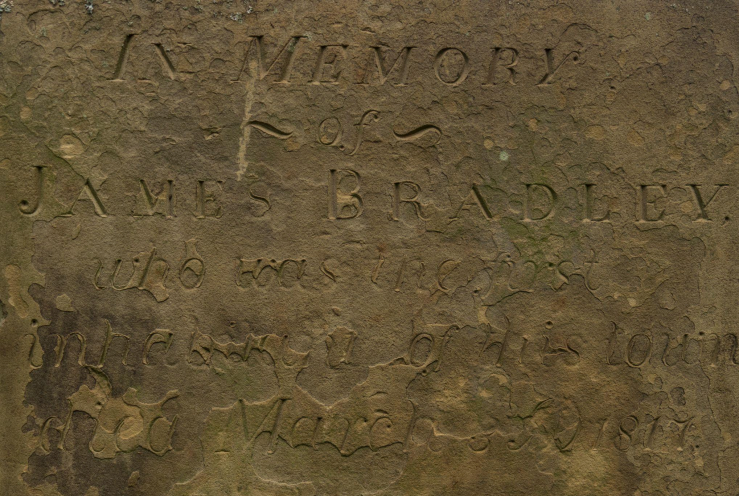
James Bradley was born June 15, 1756, in Salisbury, Connecticut, the third of four children of Ariel and Amy (Bird) Bradley. As a young man he went to New Haven, and in March 1782 he enlisted as a sergeant in the 3rd Company, 4th Connecticut Regiment under Capt. Zebulon Butler. He served until November of that year, then re-enlisted in the same regiment after it was reorganized as the 8th Company, 1st Connecticut Regiment.
Bradley’s duty placed him guarding Milford along the Long Island Sound. Though he saw no combat, the position mattered, as Connecticut’s seaport towns were vulnerable to British raids throughout the war. After thirteen months of service, he was discharged on April 29. Sometime before the birth of his first son in 1787, he married Asenath Bird.
On June 7, 1803, the family left Connecticut for Ohio. Their first destination was Canfield, in what is now Mahoning County. After a journey of roughly six weeks and more than six hundred miles, they reached the farm of Philo Breadsley, stayed briefly, then continued thirty miles north to Johnston Township. That final leg followed blazed trees and bridle paths, and often required cutting away brush so wagons could pass. The family made a stop at Warren before completing their move.
They arrived at an opening “a little west of the center” and began again, becoming the first settlers of Johnston Township. Their nearest neighbors were only a few families scattered in Bazetta, Warren, Vienna, and Kinsman. After a short time near the center, Bradley moved to the western part of Johnston, where he lived the remaining fourteen years of his life. He died March 3, 1817, at age sixty-two.
Bradley is buried at Evergreen Cemetery in Johnston Township beneath a low brownstone marker carved by Obed King of neighboring Vernon, identifying him as “the first inhabitant of this town.”
Places mentioned in this story
- Casterline Cemetery, Bazetta Township
- Vernon Center Cemetery, Vernon Township
- Evergreen Cemetery, Johnston Township
A quick note for visitors
Historic cemeteries are outdoor museums. Please be respectful, avoid touching fragile stones, and leave everything as you found it.
Written, researched, photographed, and compiled by Gavin Esposito.
This article was summarized and edited for length. To read the entirety of the author’s original writing, click below. For Trumbull 250 education and celebrations, plan a visit to Edward Drake Dray’s grave in Bazetta Township, Obed Crosby’s grave in Vernon Township, and James Bradley’s grave in Johnston Township.