">
">
As America approaches its 250th anniversary, we have been looking for the Revolution in places that do not always get put on the map.
In Part One of this series, we began tracing how Revolutionary War veterans helped shape early life in the Western Reserve, and how their stories still linger in records, family histories, and the stones that remain in our cemeteries.
Part Two continues that work with a few more veterans who later found their way to Trumbull County and its neighboring communities. Some left behind detailed pension memories, others only fragments, but together they remind us that the Revolution did not end when the fighting stopped. For many, it continued in the decisions they made, the places they moved, the churches they built, and the lives they started over in what was then the edge of the American frontier.
This is the second in a series of blogs written for the United States’ 250th Anniversary. Check out the 250 Events around Trumbull County.
Quick takeaways
- Trumbull County’s earliest settlers included many Revolutionary War veterans.
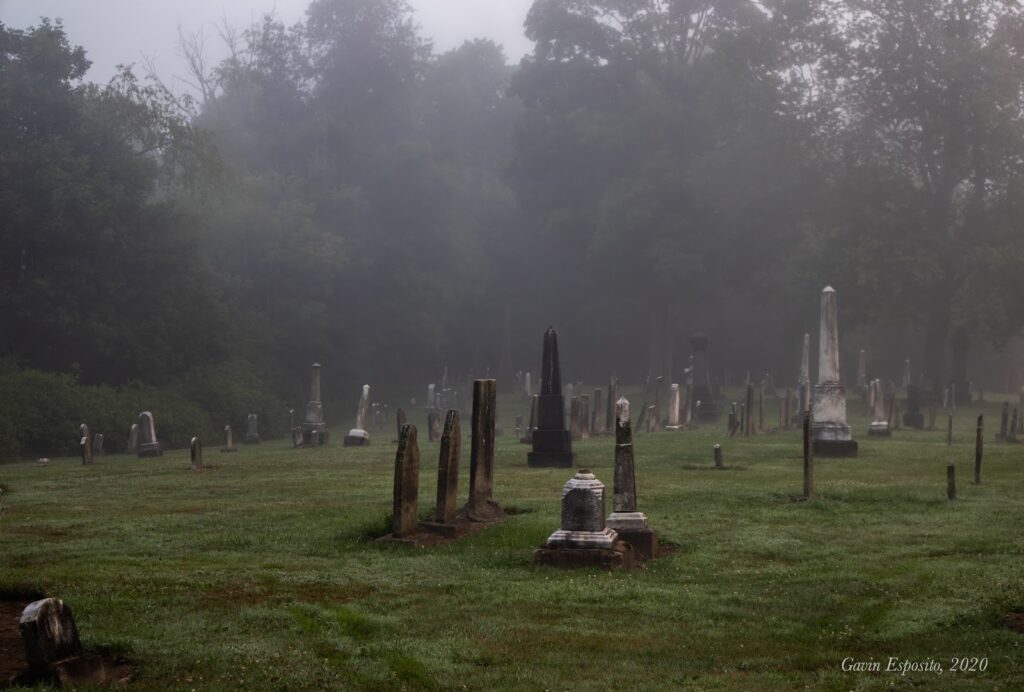
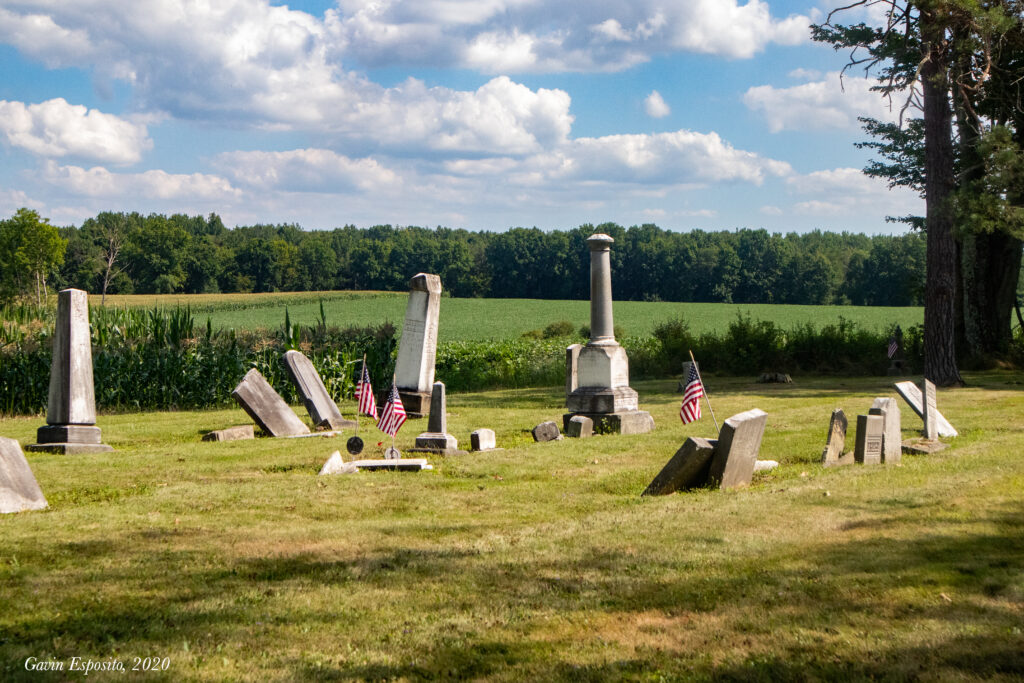
- Their stories are preserved not only in pension records, but also in local cemeteries and headstones.
- Places referenced in this post include Old Gustavus Cemetery, Vernon Pioneer Cemetery, and Kinsman Presbyterian Cemetery.
Nothing But a Plain Old Soldier
Abner C. Waters, Gustavus Township (1758–1838)
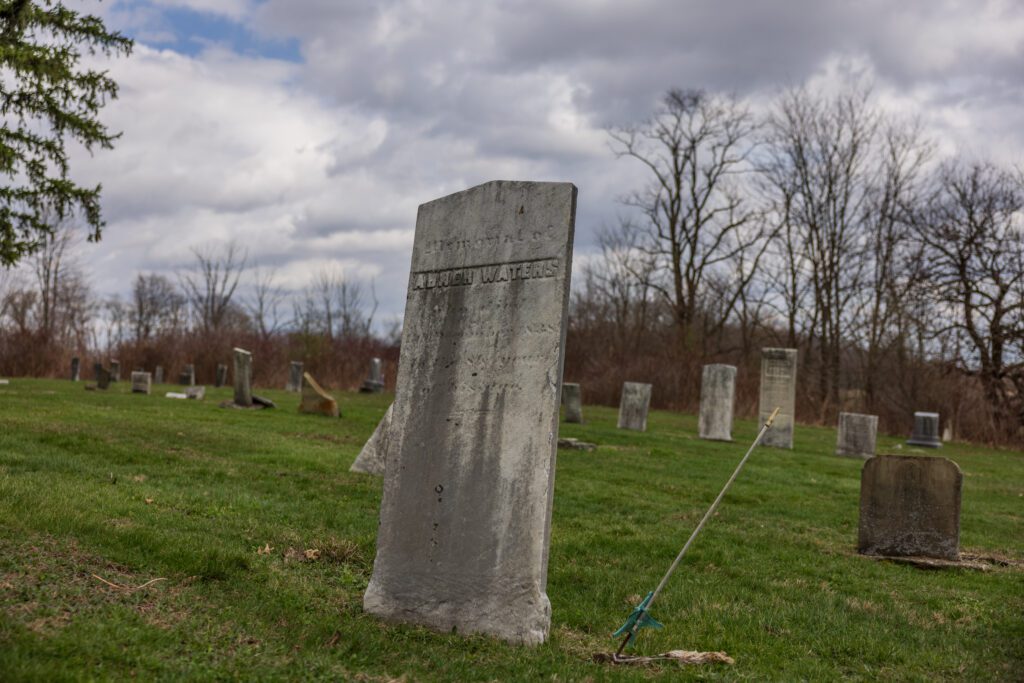
A native of Hebron, Tolland County, Connecticut, Abner C. Waters was born on April 17, 1758, the third out of five children to Abner Sr. and Lydia (Root) Waters. Moving to Hartland, Hartford County, Connecticut “when he was eight years of age,” as recalled in his pension application, Waters joined Capt. Libbens Ball’s Company, Col. Lanard’s Massachusetts Regiment as a private in early March 1776.
First stationed at Roxbury just outside of Boston, Waters arrived towards the end of the siege, where British soldiers were trapped within the city by Patriot forces posted outside of town. Transferred to Dorchester Heights on March 4, Waters “helped throw up a breastwork there” as Washington and Gen. John Thomas fortified the heights overlooking Boston with cannons hauled from Fort Ticonderoga. Bombarding the city with cannon fire day and night, the British evacuated on March 17, a feat Abner personally witnessed, noting that he “saw the British ships leave Boston harbor.”
Waters later proceeded to New York, where his company fell under the command of Col. William Shepard. He was present at the Battles of Long Island, White Plains, Pelham (called Eastchester in his pension record), and Trenton. His record gives few details, except at Pelham, where he was “sick at the time & exempt from duty.” Still, he climbed a tree to better see the action and witnessed Col. Shepard get wounded in the neck. Seeing the “blood flow freely,” Abner exclaimed, “Col., you are badly wounded,” to which Shepard replied, “the enemy are damned careless shooters.”
After the war, Abner married Phebe Holcomb in 1782. When Phebe died in 1810, Abner removed to Gustavus with his ten children in 1816. A Presbyterian in faith, he became a founding member of the Gustavus Presbyterian Church and in 1825 was elected to the congregation’s standing committee. Abner Waters died December 11, 1838, and was buried at the Old Gustavus Cemetery.
Elihu Beach I, Vernon Township (1758–1832)
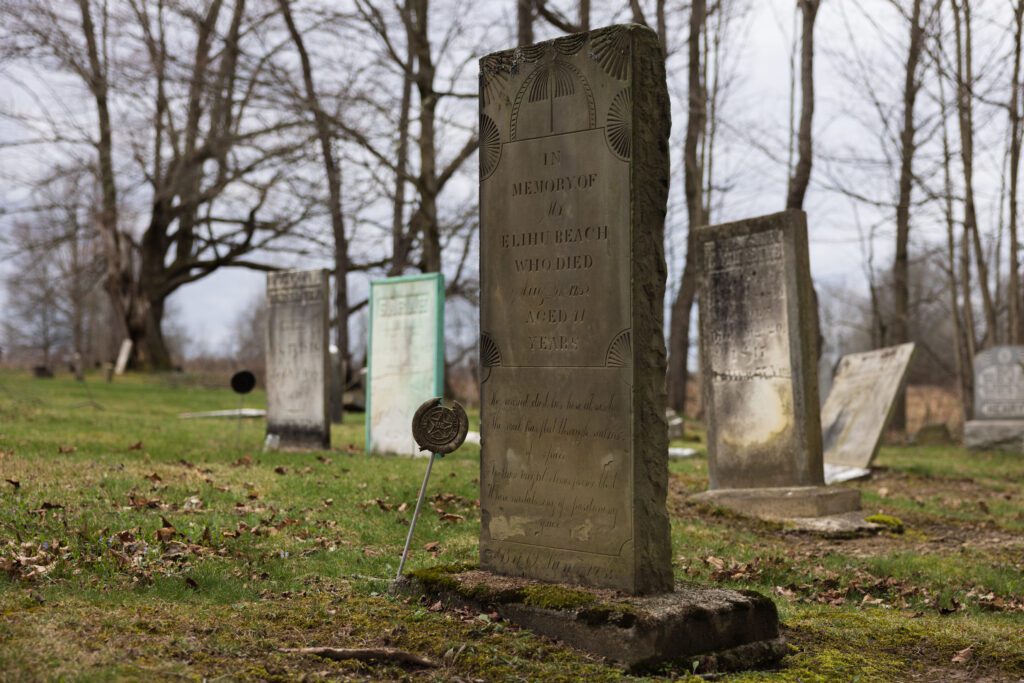
Elihu Moses Beach was born March 17, 1758, in Litchfield, Connecticut, the sixth out of seven children born to Zophar and Elizabeth (Wadhams) Beach. In March 1776, he enlisted as a private in Capt. Bezaliel Beebee’s company, commanded by Col. Philip B. Bradley of the Connecticut Line. Immediately sent to New York, he later marched to Bergen Point in New Jersey, where they “lay until the British took York Island,” the British moniker for Manhattan, following the Battle of Brooklyn Heights.
In his 1819 pension application, Elihu recorded that he “was in no battle, except a few small skirmishes,” the details of which go frustratingly unrecorded. He also noted, heartbreakingly, that he was in “indigent circumstances & stands in need of assistance from his Country for support.”
Beach married Mercy Moses on December 7, 1780, and the two settled in Hartland, Connecticut, remaining there until around 1811. A descendant, Coralynn Brownlee, suggests it was Mercy, not Elihu, who felt “the call of the west” following their son’s departure for Dryden, New York. By 1815, the Beaches arrived in Vernon, purchasing forty acres at the southeast corner of the Center of Vernon from Jeremiah and Amelia Wilcox.
Elihu applied for his Revolutionary War pension on October 6, 1819. Issued on September 2, 1821, the grantee was none other than Joshua Reed Giddings, then a country lawyer in Jefferson, Ashtabula County and father-in-law of Abner Waters’ daughter. Elihu Beach died August 9, 1832, and was buried in the Vernon Pioneer Cemetery beneath a fine sandstone marker carved and signed by local gravestone carver Obed King of Vernon.
Dr. Jedediah Burnham, Kinsman Township (1755–1840)
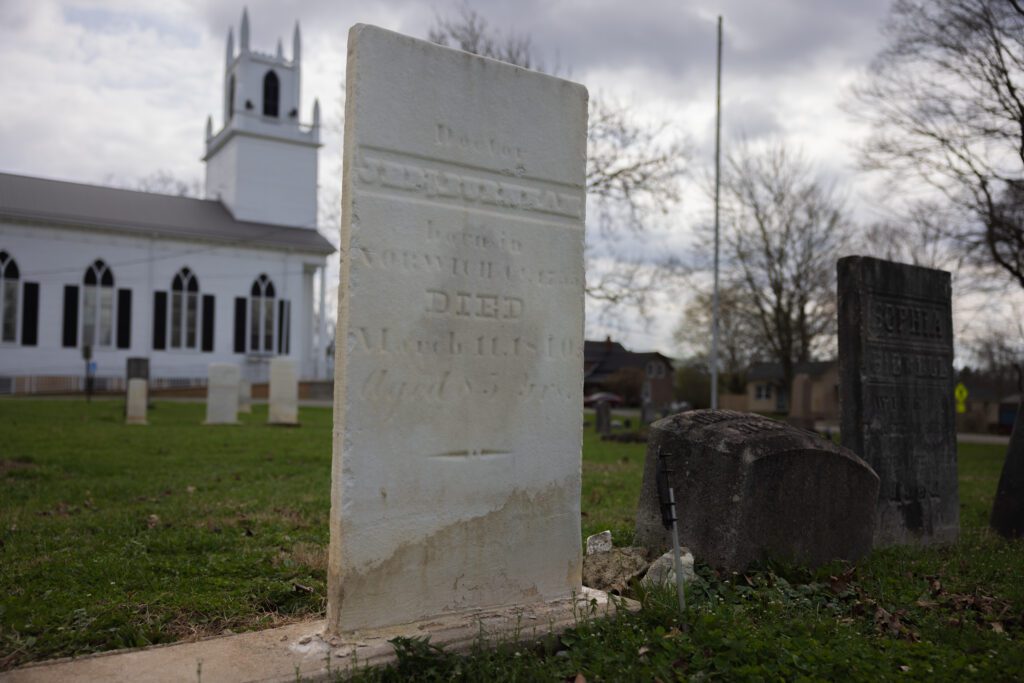
A leading resident of Kinsman, Jedediah Burnham was born April 3, 1755, in Norwich, Connecticut, the third of seven children to Capt. Benjamin and Jemima (Perkins) Burnham. Receiving medical tuition and training from Dr. Joseph Perkins, a relative, Burnham opened his own practice in New London, becoming a successful physician.
Burnham’s Revolutionary service was in the medical line. As he wrote in his pension materials, he enlisted “for the term of six months” with the provision that his services “should be in the medical line as an Assistant in the Hospital to administer to the sick.” “Not thinking” himself “very well able to perform the duties of a Soldier,” he “accordingly went immediately to the Hospital and quartered there” in hospital and regiment duties “as the first mate in the staff.” He wrote that he “fought no Battle,” nor “mounted no guard,” and was stationed at Roxbury outside of Boston until December 15, 1775, a total of five months and five days.
After service, Burnham returned to Norwich and resumed his practice. He married Lydia Kent in 1779 and the couple had three children. Around 1805, his son Jedediah Jr. was induced by John Kinsman (of Norwich) to settle in the township established eight years prior. The younger Jedediah relocated promptly, helped construct a homestead, and taught the township’s first school. The elder Jedediah and Lydia emigrated to Ohio by at least 1816 and Jedediah became a leading citizen of Kinsman.
In 1828, he was elected a deacon of the united congregation of Hartford, Vernon, and Kinsman under Rev. Harvey Coe. Upon reorganization in 1831 into the First Congregational and Presbyterian Church of Kinsman, Jedediah was among the congregation’s fifty inaugural members. Burnham’s pension was rejected in 1832 because he had not served for nine months. He died March 11, 1840, and was buried in the Kinsman Presbyterian Cemetery next to Lydia, who predeceased him. Recently, his deteriorating marble headstone was restored by Kinsman resident William Miller, along with other stones in the cemetery.
Places mentioned in this story
- Old Gustavus Cemetery, Gustavus Township
- Vernon Pioneer Cemetery, Vernon Township
- Kinsman Presbyterian Cemetery, Kinsman Township
A quick note for visitors
Historic cemeteries are outdoor museums. Please be respectful, avoid touching fragile stones, and leave everything as you found it.
This article was summarized and edited for length. To read the entirety of the author’s original writing, click below. For Trumbull 250 education and celebrations, plan a visit to Abner C Waters’ grave in Gustavus, Elihu Beach I’s grave in Vernon Township, and Jedediah Burnham’s grave site in Kinsman Township.