">
">
Nothing But A Plain Old Soldier... The American Revolution was not just a defining moment in the formation of our nation but also for the people that lived through it.
Many early settlers who came to the Western Reserve were Revolutionary War veterans, including in Trumbull County. The county itself reflects that legacy. Trumbull County is named for Gov. Jonathan Trumbull of Lebanon, Connecticut; the only colonial governor to support the patriot cause. He also served as a principal supplier of the Continental Army, coordinating shipments from his personal store to support the supply lines.
According to Katelyn Pfotus of the Trumbull County Historical Society, roughly 200 Revolutionary War veterans settled in Trumbull County (including the northern tier of Mahoning County, which remained part of Trumbull until 1846). By the 1840 Census of Pensioners, only 32 Revolutionary War veterans remained in Trumbull County.
Plan a visit to the grave sites mentioned below as part of Trumbull 250 and stand next to a part of Trumbull County’s history.
Edmund Clarkson Burnett (Hubbard Township) (1756–1838)

Edmund Burnett’s stone is heavily weathered and virtually devoid of lettering. (Photo by author)
According to Rev. N. H. Dorhan, compiler of History of Hubbard, Ohio, From Early Settlement in 1798 to 1907, Edmund Burnett was Welsh by birth. However, historical evidence places his origins in Morris County, New Jersey. He was born January 1, 1756. He was the eldest of eight children of Matthias and Dorcas (Conger) Burnett. Edmund’s father graduated from Princeton in 1769 with a doctorate of divinity and became pastor of the Presbyterian church in Queens, New York.
Edmund did not enter the ministry. Instead, he enlisted during the Revolution.
Service highlights (short timeline):
- June 1776: Enlisted as a private in Capt. David Bates’ Company, Col. Martin’s New Jersey Regiment (five-month term).
- August 27, 1776: Fought at the Battle of Long Island (also called the Battle of Brooklyn).
- Stationed briefly at Fort Washington, then marched to White Plains.
- October 28, 1776: Fought at the Battle of White Plains.
- Afterward, he moved through Tarrytown Bay (North River), then Newark, Elizabethtown, and Brunswick.
- November 1776: Discharged after five months.
- December 1776: Drafted again and marched with Capt. Obadiah Ritchel, Col. Ford’s New Jersey Regiment to Elizabethtown, where he served for much of the next eight months.
- July 1777: Discharged.
After the war, Edmund married Sarah Smith. He lived in New Jersey for about twenty years. In 1797, Edmund, Sarah, their seven children, and his brother Enos moved to Washington County, Pennsylvania. They lived there for six years. Then, in 1803, the family moved to Hubbard, where they stayed for the rest of their lives.
On May 22, 1833, Edmund applied for a pension under the Revolutionary War Pension Act enacted the year before. He received one on the stipulation that he had more than six months of service. Edmund Burnett died on February 12, 1838, at age 82, and was buried in the Old North Cemetery in Hubbard beneath a small sandstone marker. The stone is now heavily weathered, and almost no lettering remains. Fortunately, someone recorded the verse earlier:
“I am an old revolutioner; the battles I fought
That victory won and freedom has bought
All honor and glory I leave on record
And march to heaven to reap my reward.”
Ezra Rawdon (Warren Township) (1762–1824)
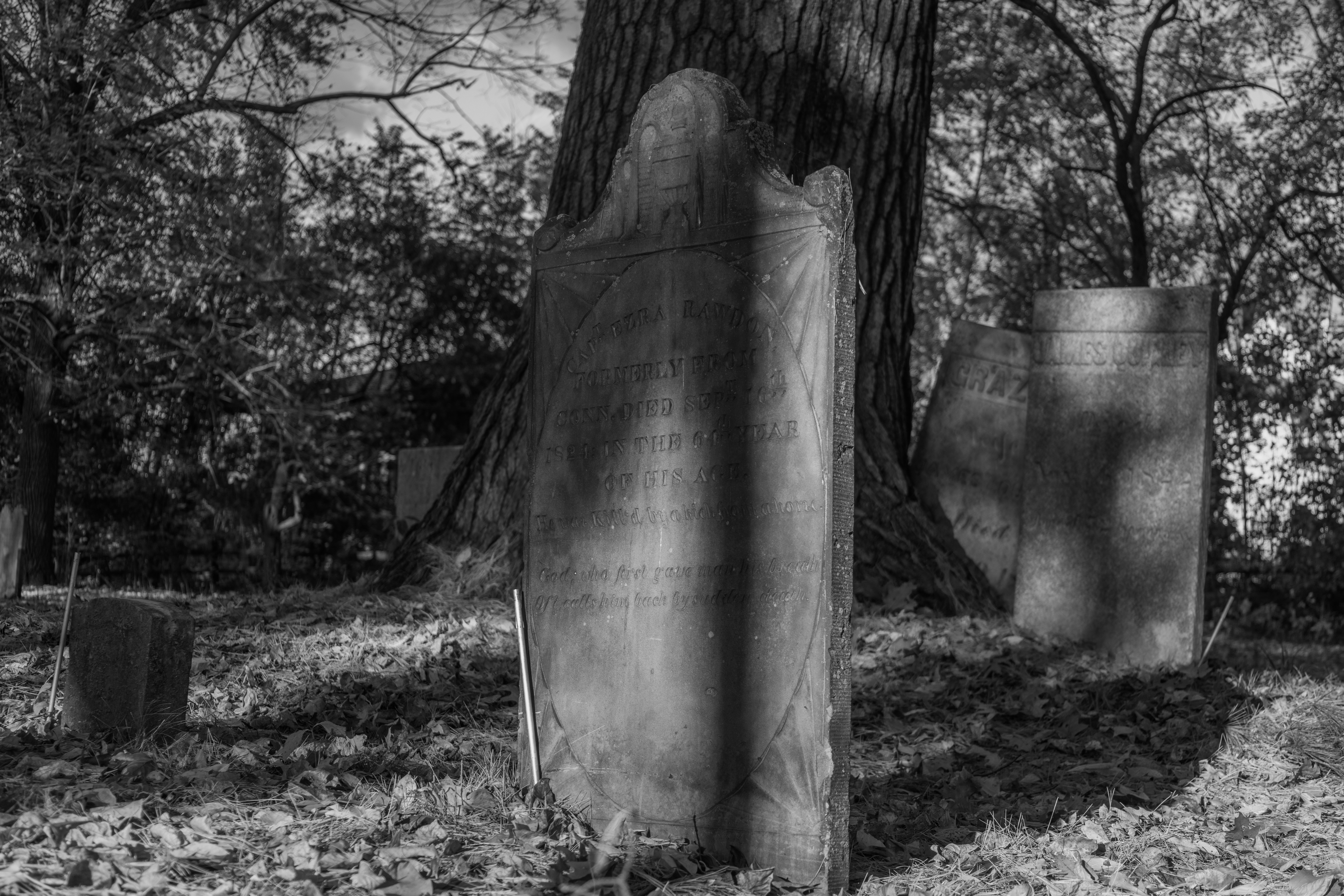
Ezra Rawdon’s marker records that he was “kill’d by a kick from a horse.” (Photo by author)
Ezra Rawdon was born March 11, 1762, in Tolland, Tolland County, Connecticut. He was the second of eight children of Thomas and Lydia (Bosworth) Rawdon. He married Sarah Lathrop on November 10, 1783. Much of what we know about his service comes from Sarah’s widows’ pension application dated February 4, 1843.
Sarah wrote that Ezra enlisted at the town of Tolland and served for three years with Col. Elijah Robinson’s Regiment. She also said she often heard Ezra say he was “in the army” and that he was present near the execution of Maj. Andre, and that he was also at West Point. Sarah did not record exact dates for his service. However, because Maj. Andre was executed in 1780 and Sarah said they did not marry before he left the service, his service likely fell within the years before their marriage in 1783.
Ezra still lived in Tolland in the 1810 census. Sometime after that, Ezra, Sarah, and their three children, Jeduthan, Horace, and Lois, moved to Ohio with five of Ezra’s brothers. The brothers went to Windsor, Ashtabula County. Ezra and his family went to Warren.
Ezra died on September 16, 1824, at age 64, when he was “kill’d by a kick from a horse.” His sandstone marker at the Mahoning Avenue Pioneer Cemetery (Old Mahoning Cemetery) in Warren records that cause of death rather than his Revolutionary service.
Asa Andrews (Hartford Township) (1756–1813)

Asa Andrews’ marker does not mention his service, but the 1938 family history preserves it. (Photo by author)
Asa Andrews was born October 25, 1756, in East Haddam, Middlesex County, Connecticut. He was the tenth of thirteen children of Capt. Nehemiah and Hannah (Borden) Andrews. Unlike the men above, Asa’s enlistment record does not come from pension files. Instead, it comes from William Andrews of Hartford, Conn. and His Descendants…, a family history published in 1938 by a descendant.
Asa enlisted on January 25, 1777, in Capt. John Barnard’s 3rd Connecticut Regiment, commanded by Capt. Samuel Wyllys. Over the course of the war, he rose through the ranks:
- Promoted to sergeant on July 10, 1777
- Promoted to quartermaster sergeant on September 1, 1780
- Appointed provost marshal by July 19, 1781, at Dobbs Ferry, Westchester County, New York
Dobbs Ferry is the only location in that report. From there, four days after Asa’s appointment, George Washington and French general Jean Baptiste Donatien de Vimeur, comte de Rochambeau, launched the Reconnaissance of New York. They intended to take the city back from the British. Soon, they found the combined Franco-American force too small. They shifted efforts toward Yorktown, Virginia. Thus, on September 28, 1781, the Cornwallis surrendered, which brought the Revolution to a close. The record does not say whether Asa Andrews took part in the Reconnaissance of New York, or in any battles.
After the war, Asa lived in Hartland, Hartford County, Connecticut, about 50 miles north of East Haddam. On November 27, 1783, he married Lucy Ackley, also from his hometown. Asa lived in Hartland until 1804. Then Asa, Lucy, and their six sons moved to Hartford Township, Trumbull County, Ohio. Asa’s brother-in-law, Thomas Bushnell, traveled with them. Bushnell had married Asa’s sister, Rebecca.
Asa Andrews died on February 25, 1813, at age 57, during an “epidemic of sickness” that claimed 15 early township residents. He is buried in Hartford Township Cemetery beneath a sandstone marker decorated with two weeping willows flanking a central obelisk, likely the work of gravestone carver Elijah Sikes of nearby Brookfield.
This article was summarized and edited for length. To read the entirety of the author’s original writing, click below. For Trumbull 250 education and celebrations, plan a visit to Edmund Clarkson Burnett’s grave in Hubbard Township, Ezra Rawdon’s grave in Warren Township, and Asa Andrews’s grave site in Hartford Township.