">
">
The walls of Downbeat Musical Arts Centre on East Market Street in Warren do not just decorate a music studio. They narrate.
Read part one here.
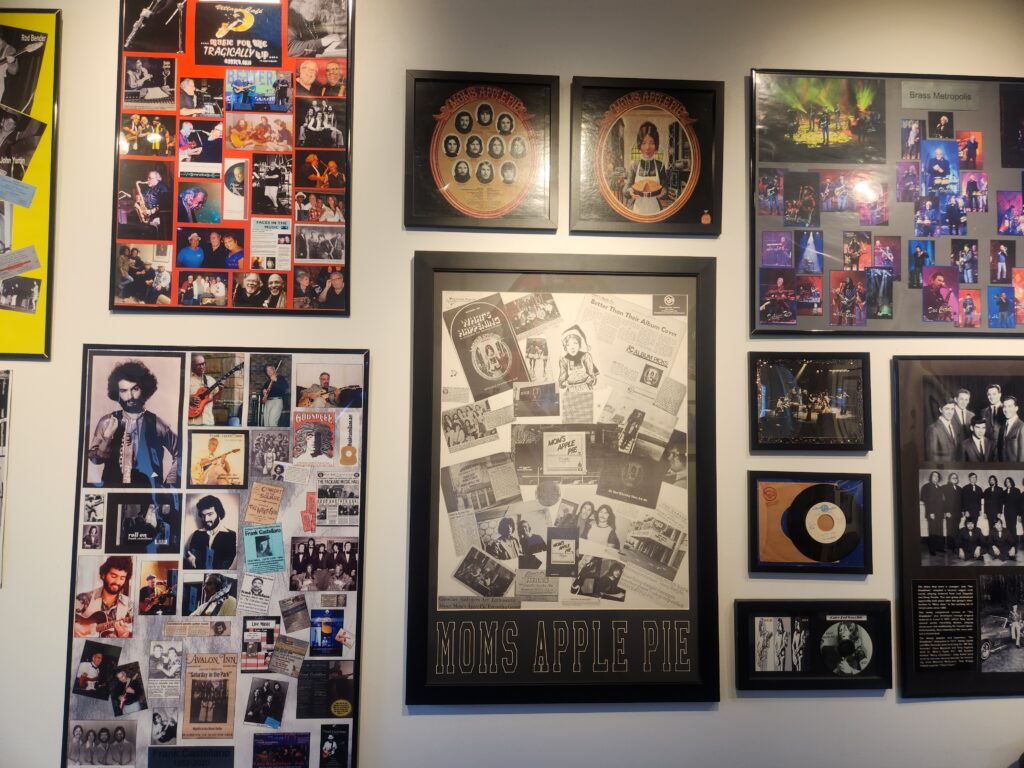
Framed photographs and clippings form a visual timeline of Trumbull County’s musical pulse, a quiet gallery where local ambition once competed with the national stage. There are shots from the early 1970s of sharp‑suited show groups posed under hotel marquees, young men in the awkward confidence of garage bands. Interspersed are images of Mariano Longo himself — a teenager gripping a microphone in a church basement, a polished pianist in Las Vegas showrooms, and the seasoned mentor who returned home decades later to build this laboratory for the next wave.
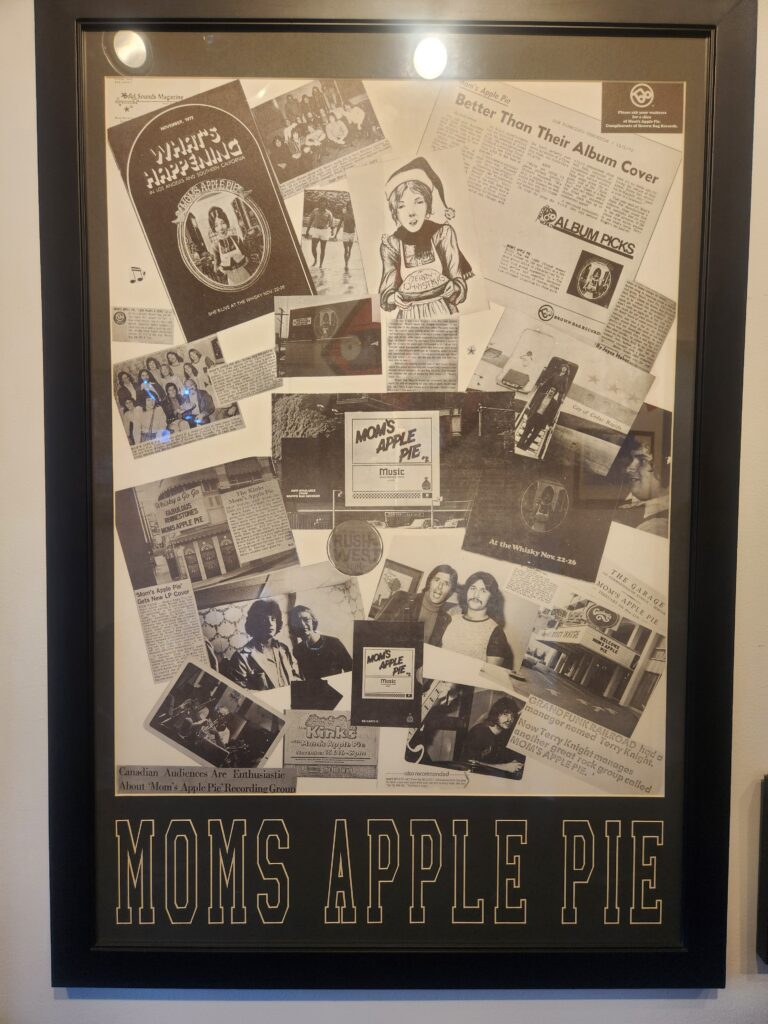
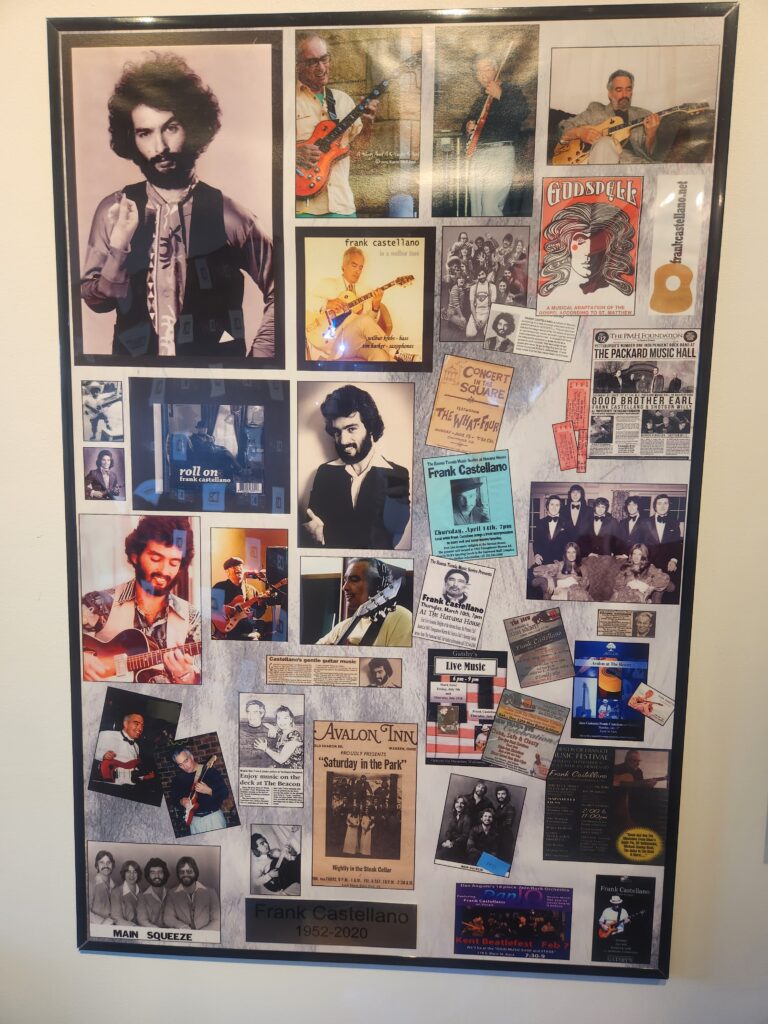
One wall holds an homage to Mom’s Apple Pie, the Warren 10‑piece that blended twin lead vocals, horns, and a prog‑leaning classic rock sound. Nearby hang images of The Shadows, Group Therapy, and other local acts that once packed Cherry’s Top of the Mall, the Oak Room in Sharon, and stages at the Eastwood Mall. Further along, Longo appears beside Wayne Newton, the icon whose touring band he still joins on piano, and with names like Gary Puckett, The Buckinghams, Lesley Gore and Little Anthony and the Imperials — artists whose catalogs he has arranged and conducted.
Longo went through a thick scrapbook and began turning pages. The earliest photographs place him at 17 or 18 in the basement of Howland Community Church as he recalled early gigs at “Canteens” after football games on a Friday night.
He recalled, “and bands would play in this little church hall with the stage and everything, and that’s where these were taken.” Publicity meant newspaper blurbs and hand‑distributed flyers. Without the conveniences of the internet Mariano said you had to get “…real grassroots, you had to hit the ground.”
The transition from church basement to the road came through Pat Padula, a Warren native and journeyman musician who had tasted national success. Padula founded Destiny Incorporated, a production company.
“Destiny was, for lack of a better word, a factory, a production factory to create touring entertainment,” Mariano said. Padula saw that “this area [had] an overwhelming amount of talent, but no focus to steer that talent.” Destiny packaged singers, players, and full show groups and sent them into a pre‑cable universe of hotel lounges, restaurant bars, and clubs. “There was no cable television. There was no internet. There was not MTV. Nothing.”
“It sounds like it was almost like a Motown,” the question came.
“Yes, absolutely,” Mariano replied. “A mini Trumbull County Motown… a factory where acts could be packaged and put out on the road.”
Among those acts were the Rocco Sisters, L.A. jazz singer Mickey Lynn fronting “four suburban white kids from Trumbull County,” and Longo’s own early folk‑rock outfits. One photo shows them at the El San Juan Hotel in Carolina, Puerto Rico, in a room improbably named the Hunka Munka Room, glittering under tropical lights.
Back home, Longo joined Group Therapy, a Warren band so popular that local clothing stores sponsored their suits. “There was so much work,” he recalled. “In those days, we could work six to seven nights a week. If we wanted to play seven, we could… I bought my first house when I was 22. It was just a whole different landscape.” Places like Cherry’s Top of the Mall — “a sort of mafioso kind of joint… but they always had great entertainment there” — made the region feel like its own circuit.
By 1980, under Padula’s eye the act evolved into Sir Bentley. They filmed a television pilot in Cleveland with help from Chuck “Big Chuck” Schodowski of the ‘The Big Hoolihan and Big Chuck Show’ that Mariano described as “a cross between The Monkees and the Bowery Boys,” scored with his own theme patterned after the bright funk of Sanford and Son. “It never went anywhere,” he said, “but at least they filmed it, and we starred in it.”
The same period took them to the outdoor amphitheater at Hershey Park in Pennsylvania. “We did three shows a day… for thousands of people,” Mariano recalled. “It was a big, big thing… It would be like Disney World.”
Then the landscape of music shifted. The 1980s brought drum machines and synthesizers. Longo and a drummer partner began producing their own tracks and performing to those recordings. The scrapbook thickens with laminated press clippings — “the only way we could save them,” he said — from an era when “’65 through ’85” felt like “a magical, magical, creative, live music time.”
Somewhere in the late 1980s, the work dried up.
“When Marriott said, ‘We’re out of the food and beverage business,’” Mariano recalled, “that was like the Ford Motor Company saying, ‘We’re going to make a three‑wheel car.’” The chain ripped out lounges and full restaurants in favor of meeting rooms it could lease and once Marriott made that move, Sheraton, Ramada, Holiday Inn, Westin, and others followed. Food had never yielded big margins, liquor now carried legal and security risks and, as Mariano put it, corporate “bean counters” realized they could make more money with convention space, slot machines, or bingo than by paying bands to work six nights a week.
The result, as he put it, was blunt: “It wipes out an entire generation of working musicians, and I can’t say that in a more profound way.”
By the 1990s, Longo was in Las Vegas still playing showrooms in casinos that had not yet fully surrendered to slot machines. Even there, he said he watched the same corporate logic erode the old model.
Today, Mariano sees signs that the region is finally closing that gap. “Now you have like Sean Jones… Kelly McCracken… her new group, Flying Underground… just great songwriting,” he said naming them alongside the Vindys and the Labra Brothers as acts that “could break out too, no question.”
What the scrapbook cannot fully show is the missing ingredient Longo identifies as the region’s real deficit: hit songwriting. “I think what this area lacked, the only thing it lacked, was songwriting,” Mariano said. “If any one of these groups would have had a hit songwriter in them, they’d still be touring today.”
He described Warren’s scene as “comprised of journeymen musicians… great cover bands… great singers,” but “not a Lennon and McCartney, not a Stevie Wonder, not a Brian Wilson.” A single song, he insisted, can be “transformational… It takes you out of being a struggling journeyman musician to actually being able to compete on a national stage.”
That diagnosis shapes what Downbeat Music Studio is now. “We’re presenting a vibe where creativity is still relished and valued,” Mariano said. “This place is not meant to be some money maker… this is a place for development, a laboratory.”
Young artists like Aaron “Aairo” Parker, Garrett Fry, and Rebekah Mancino work alongside veterans who expect results. “We’re throwing them right in the deep end with older musicians,” Mariano said.
Then there’s a recent encounter Mariano talked about with a high school guitarist from Howland who recently walked in “full of steam.”
Longo said the young musician has sat during rehearsals with veteran bands. “When you experience the speed and the velocity of how this is moving… if you walk through the door again then we’re ready to start doing something. You may never walk through the door again.”
“Everybody’s a big shot in a little arena,” he added. Online, “somebody can get on there and play at 90 miles an hour for 30 seconds, and everyone goes, ‘Oh, look at this! He’s great!’ But can he walk through the door, play in a band, organize themselves, get paid, and make enough money to do it again?”
That question links the photos on the wall to the kids in the room.
Longo pointed to a younger image of himself at the young guitarist’s age on Howland Springs Road supported by his parents. “They were just blue‑collar folks, working folks,” he said. “The easiest thing for them to do would have been say, ‘Go to Packard Electric or go to GM, get a job.’ But for them, it was absolutely visionary to encourage me.”
Those same parents, Mariano said watched him move from that church‑basement snapshot to stages with Wayne Newton in Las Vegas showrooms and performing arts centers. The distance between those images is measured in decades of six‑night weeks, failed pilots, corporate pivots, and stubborn persistence.
Today, the walls of Downbeat close that distance for a new generation. The photos of Mom’s Apple Pie, Group Therapy, The Shadows, and the Destiny acts are no longer just memorabilia but case studies. The music, Mariano insists, is still “interwoven into that interpersonal experience” with the dancing, the talking, the act of showing up in person. All that is required now, as then is the courage to walk through the door and stay.