">
">
Step onto Courthouse Square in downtown Warren and explore one of Northeast Ohio’s most photogenic historic districts. This easy, self-guided walk highlights the Romanesque Trumbull County Courthouse, the early-1900s Franklin Building, and the Moorish-inspired Park Hotel.
Courthouse Square, Warren
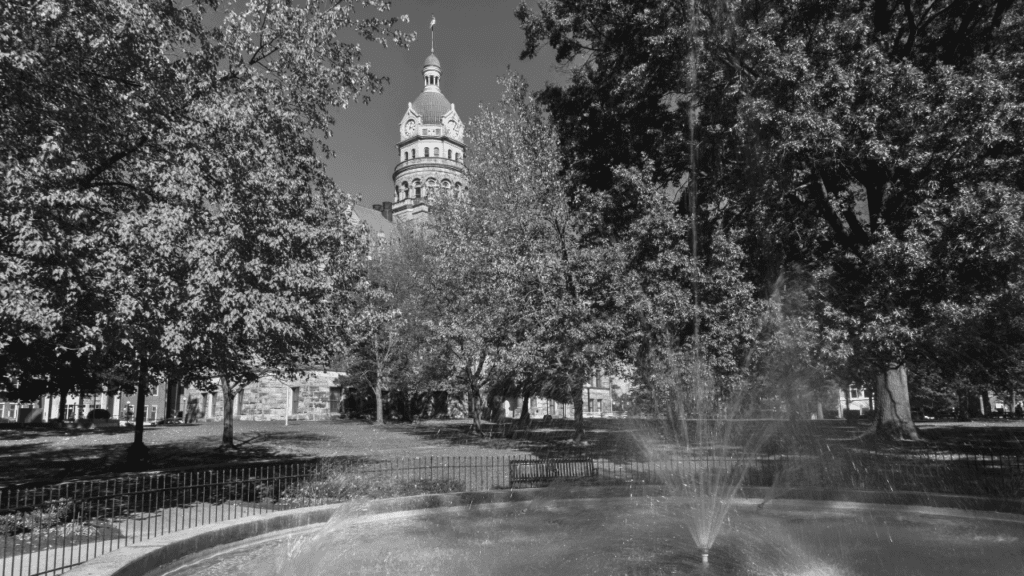
Naturally, the nucleus of Courthouse Square is a 4.5 acre square lot capped by the county courthouse, set aside by Ephriam Quimby in 1800 for “publick use.” (Photo by the author).
Warren, the county seat of Trumbull County, was first viewed by settlers from the East in the autumn of 1798. That year, Ephraim Quinby and Richard Storer of Washington County, Pennsylvania, came to inspect the recently surveyed lands of the Connecticut Western Reserve. They went first to Poland, then to Youngstown, and finally to Warren.
Quinby and Storer purchased tracts of land, packed their saddlebags with soil samples, and returned to Pennsylvania before winter. Before leaving, Quinby bestowed the name “Warren” in honor of Connecticut Land Company surveyor Moses Warren, who had surveyed the area only months earlier. The following spring, the two men – along with fifteen others – set out for Warren and arrived on April 17, 1799. On July 10, 1800 – after President John Adams signed the “Quieting Acts,” which dissolved Connecticut’s claim to the Reserve – Trumbull County was created, with Warren designated as the county seat.
Some say Warren was the “capital” of the Western Reserve; that is not entirely incorrect. From its inception until 1806, when counties began to be partitioned, Trumbull County extended as far west as Sandusky Bay. At first, the settlement was a simple encampment of log cabins, cornfields, and fruit trees. By the end of 1800, Capt. Quinby surveyed the town, laid out streets, and set aside a square for “publick use,” following the pattern of New England villages.
Although the community grew steadily, by 1804, some proposed moving the county seat to Youngstown, then the larger settlement. The effort failed. In the two centuries since, Warren has remained the seat of Trumbull County and has amassed many fine structures in a range of styles. This self-guided tour highlights several of Courthouse Square’s most distinctive buildings.
Trumbull County Courthouse
160 High Street, Warren
Style: Romanesque Revival
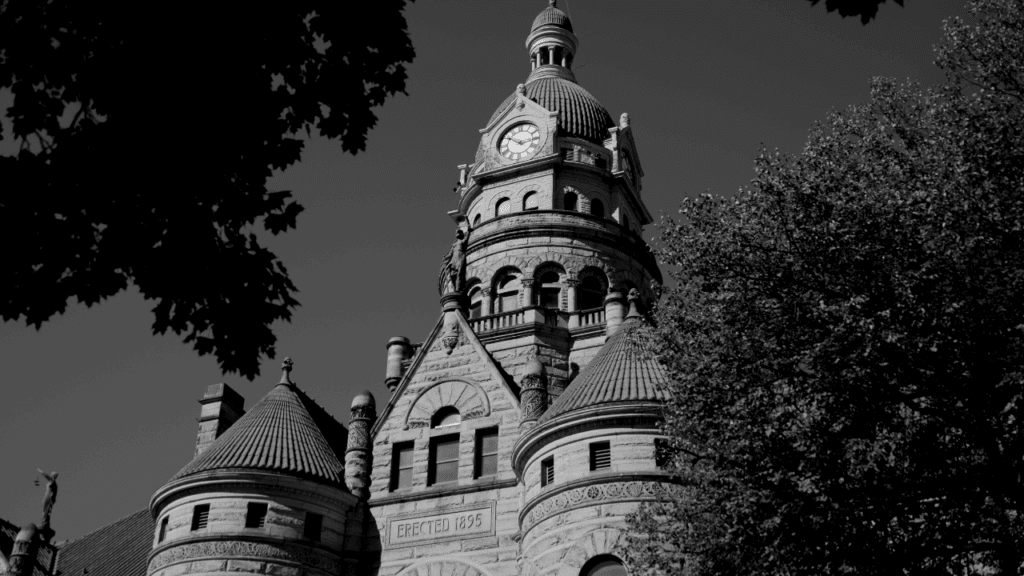
Constructed in 1895. The present Trumbull County Courthouse was constructed in the Romanesque Revival style. It is the third such seat of justice to serve the people of Trumbull County upon this site. (Photo by the author)
The present-day Trumbull County Courthouse—the third to serve the people of Trumbull County—traces its roots to 1815, when the county built the first courthouse on this site. An etching in Henry Howe’s Historical Collections of Ohio (1846) depicts a modest, gable-fronted building of clay brick. By 1836, residents already considered it “too small” for a growing population. Crews demolished the original in 1852, and Richards and Logan of Poland, Ohio, designed a grand Greek Revival replacement. Builders used stone quarried in Vienna, Coitsville, and Braceville townships. The new courthouse opened in 1854 and stood for 41 years, until a devastating fire on March 25, 1895, destroyed it.
After the fire, judicial operations moved to the Packard Block on North Park Avenue while the county prepared plans for a new courthouse. The contract went to LaBelle & French of Marion, Indiana, with E. M. Campfield of Findlay, Ohio. On November 28, 1895—Thanksgiving Day—the first cornerstone was laid. Designed in the Richardson Romanesque style – drawing on eleventh – and twelfth-century European precedents and the work of Henry Hobson Richardson (1838–1886) – the courthouse features cylindrical turrets, broad arches, and bold stonework. On January 25, 1897, at 4 p.m., the clocks in the massive cupola were started. On April 5, 1897, the commissioners took possession, and on May 10, the courthouse was officially dedicated with the opening of the court’s May term.
Franklin Building
100 North Park Avenue
Style: Eclectic
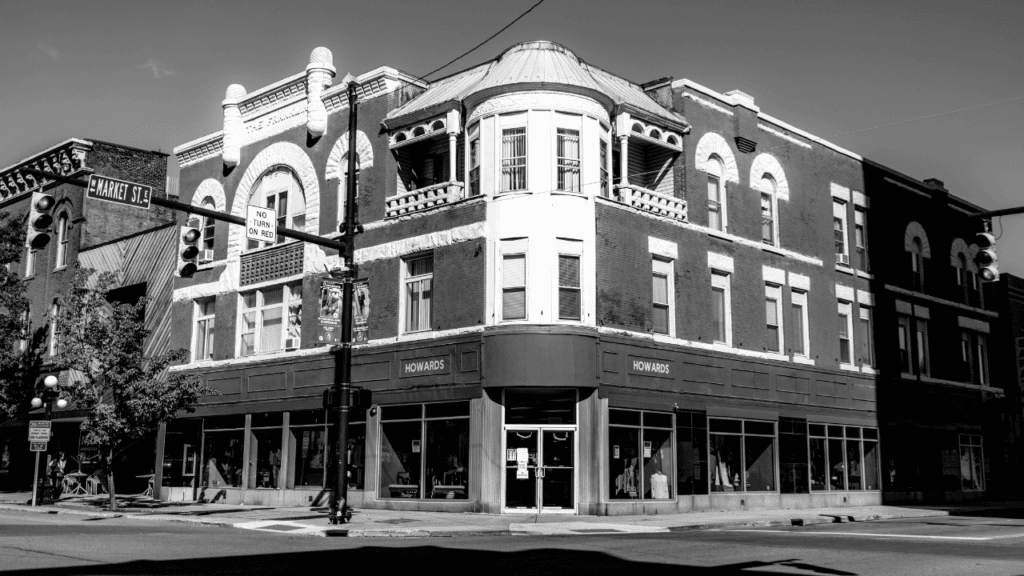
A fixture at the corner of East Market and North Park Avenues for well over a century. The construction date of the Franklin Building is not known. A rough guess can be made from the Sanborn Fire Insurance Map, which shows it standing by September, 1902. (Photo by the author)
One of the first buildings seen on Courthouse Square when entering Warren from the east, the Franklin Building appears on the September 1902 Sanborn Fire Insurance Map. In its earliest use, it housed the Warren Savings Bank and the offices of Dr. H. E. Dunn. By 1910, it was home to Park Pharmacy, operated by J. E. McClure until 1930, when that year’s city directory listed the building as “vacant.”
By 1932 it was occupied by the Darling Shop. That tenure lasted until at least the 1940s, when Gray’s Drug Store moved in. A Cleveland-based chain founded in 1912 by Hungarian immigrant Adolph Weinberger. Although the original contractors are unknown, they clearly intended a distinctive design. Blending Romanesque features with late-Victorian splendor, evident in the corner turret.
Park Hotel
136 North Park Avenue
Style: Victorian (With Moorish Revival Elements)
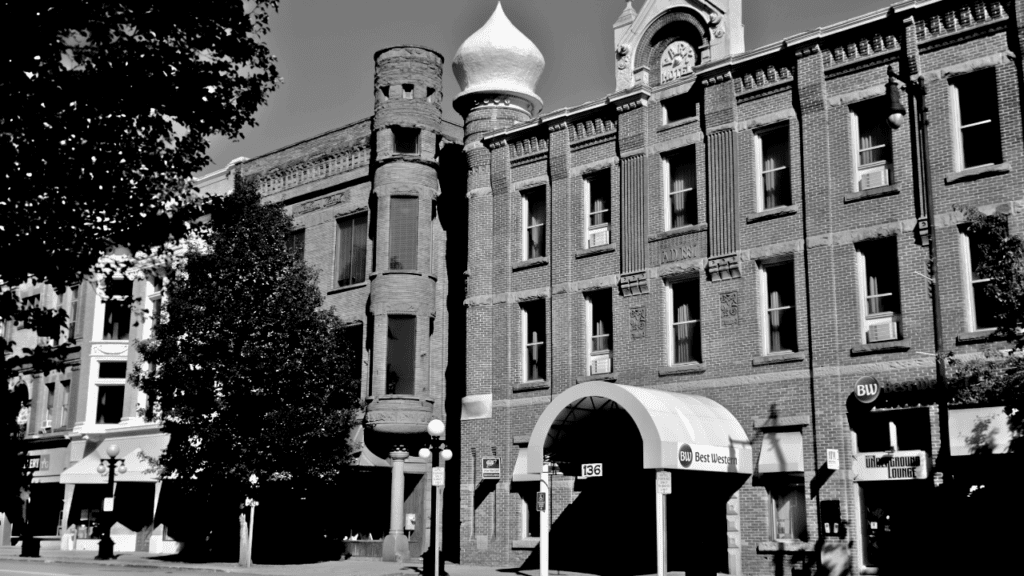
As early as 1813, a hotel sat on the site of where the present-day Park Hotel stands. Erected in 1887 in the Moorish Revival style. (Photo by the author)
As early as 1813, a public house served weary travelers on the site of today’s Park Hotel in Warren. Cyrus Bosworth of Roxbury, Suffolk County, Massachusetts, built the hotel. Known as the National Hotel, it operated under that name for sixty-eight years. In 1881, George M. Garrett and Hiram Clark purchased the building and renamed it the Park Hotel. The old structure stood until 1887, when crews demolished it. In its place, builders erected a massive new building – the Park Hotel’s new home.
Designed by Youngstown-based architect Charles F. Owsley, the structure rose three stories and featured late-Victorian elements such as brick construction and a corner turret. This along with Moorish Revival details including terra-cotta trim around the windows and upper cornices and a bulbous, conical roof. Moorish Revival architecture gained attention in the United States after Washington Irving’s 1832 Tales of the Alhambra. The style draws on Islamic motifs, particularly those of the Moors of North Africa. As a rule, Moorish Revival structures are rare – often theaters or synagogues – making the Park Hotel a distinctive early example of the style.