">
">
A Small Cemetery With Deep Vernon Township Roots
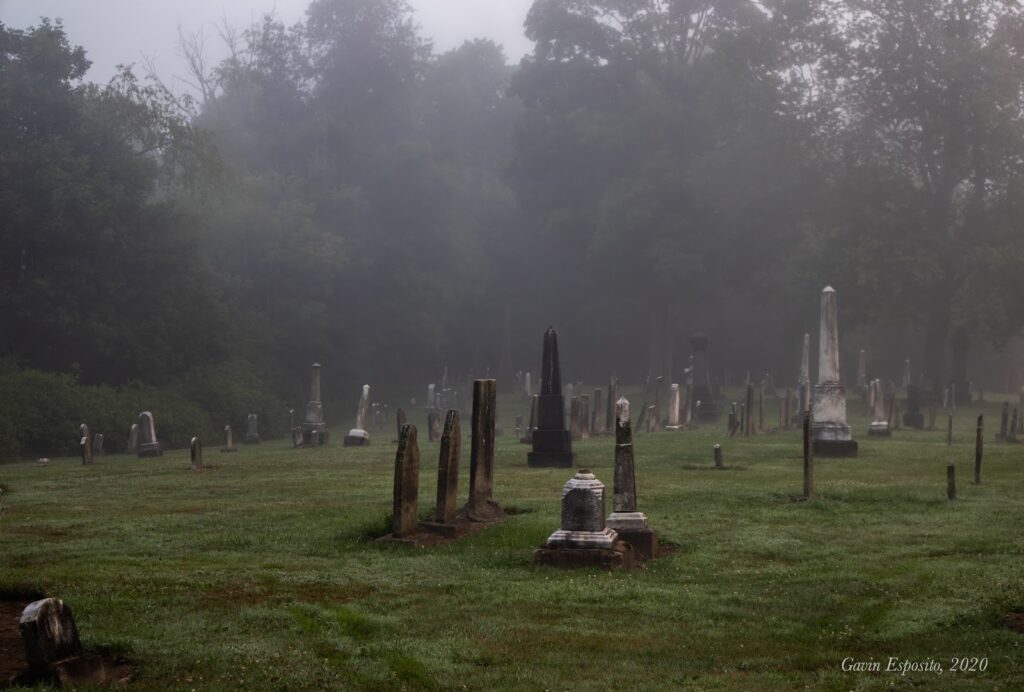
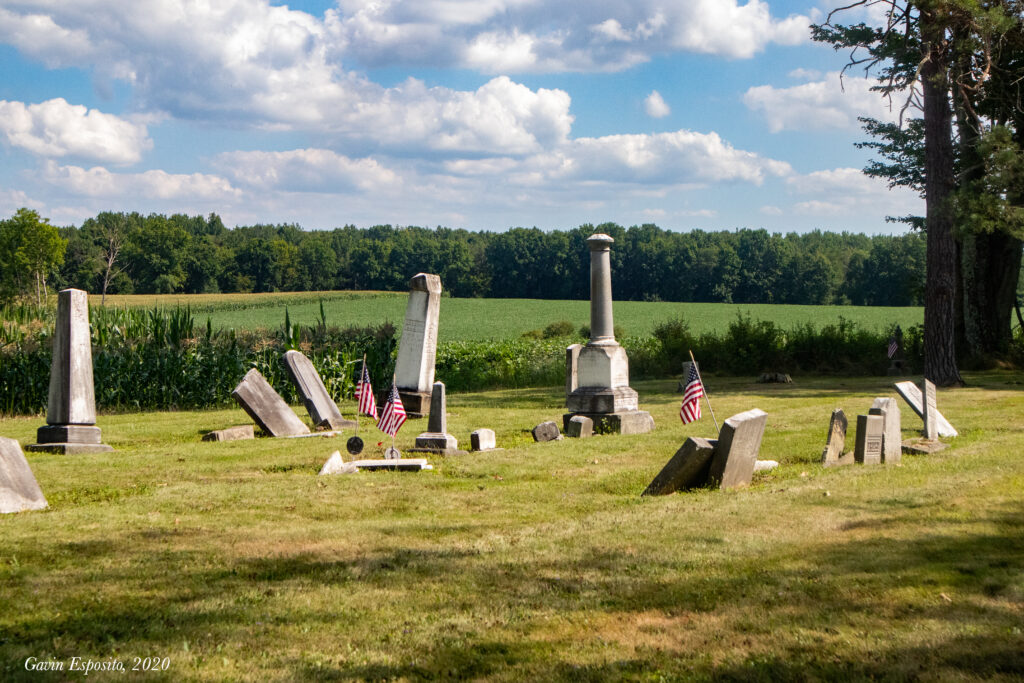
Enclosed by a modest white fence and tucked between homes, Giddings Cemetery is easy to miss. But this small Vernon Township burying ground is tied to some of the earliest stories of settlement in this part of Trumbull County.
Quick Takeaways
- Giddings Cemetery was used as a burying ground as early as 1813.
- The first known burial was William Brown, who died in 1813.
- The cemetery is named for Thomas Giddings, one of Vernon Township’s earliest settlers.
- The cemetery is only about half an acre in size.
- It was formally conveyed to Vernon Township trustees in 1843.
- Regular burials continued into the 1890s, with the last burial occurring in 1939.
- The cemetery connects to early settlement, the War of 1812, the Bliss family, gospel music history, and nearby Hartford Township.
Thomas Giddings and the First Years of Vernon
The cemetery takes its name from Thomas Giddings, a native of Hartland, Connecticut.
Giddings was born on January 27, 1776, the only child of Elisha and Susannah Perkins Giddings. Orphaned at just one year old, little is known about his early life until 1798, when he was hired by Dr. Jeremiah Wilcox to survey land in what is now Vernon Township.
He was only 22.
Giddings came west with Martin Smith, another Hartland native. Smith would first give the unnamed township the name Smithfield, later changed to Vernon in 1815.
After crossing the Allegheny Mountains and arriving near the Ohio-Pennsylvania line, Giddings and Smith traveled by boat through the Shenango and Pymatuning waterways. They reached Vernon on June 19, 1798, about a half mile south of the present town center.
The next day, they found a spring, an essential first step for settlement, and built a crude shelter nearby. According to tradition, the logs were cut by Thomas Giddings himself.
By 1800, Giddings had returned to Connecticut, married Lydia Brockway, and brought his new bride back to Vernon. They became the first members of the Giddings family to settle in the Western Reserve.
More members of the family followed. Among them was Thomas’ cousin, Joshua Reed Giddings, who later became a respected lawyer and abolitionist congressman from Ashtabula County.
During the War of 1812, Thomas Giddings organized a company under the Fourth Regiment of the Ohio Militia. Details of his service are limited, but the company carried his name.
Lydia Giddings died in 1826 at only 45 years old. She was buried in the little cemetery near where she had lived. Thomas later married Mary Gault, and in 1843, he and Mary conveyed the cemetery to the trustees of Vernon Township.
Mary died six years later. Thomas died in 1865. Both were buried in the cemetery that still bears the Giddings name.

In a sad twist, the stones marking Thomas, Lydia, and Mary are no longer visible. Time has worn them down and taken them back into the earth. Their names, however, remain attached to the place.
James and Reliance Bliss
Some of the cemetery’s quietest stones lead to one of its most unexpected stories.
In 1844, Isaac and Lydia Bliss moved from Clearfield County, Pennsylvania, to Kinsman Township with their children: Phebe, Reliance, Philip, and Elizabeth. Isaac was remembered as a deeply religious Methodist, a man who lived with constant faith and raised his children in the same spirit.
Two years later, the family welcomed another son, James.
But tragedy soon followed.
James died on February 15, 1847, at just one year old. Nine months later, his 13-year-old brother Reliance also died. Although the family lived in Kinsman, both boys were buried in Giddings Cemetery. The reason is unknown.

The Bliss family soon left Trumbull County for Pennsylvania. Their time here was brief, but it shaped one family member in a lasting way.
Their brother Philip Paul Bliss would become one of the most famous gospel hymn writers of the 19th century.
As a child in Kinsman, Philip heard a piano for the first time. Drawn to the sound, he followed the music into a home and stood listening at the parlor door. The moment stayed with him.
Years later, Bliss studied music, moved to Chicago, and began writing hymns. His songs included “Hold the Fort,” “Let the Lower Lights Be Burning,” “Pull for the Shore,” and “Hallelujah, What a Savior.”
Philip Bliss later returned to Northeast Ohio under tragic circumstances. On December 29, 1876, he and his wife, Lucy, were killed in the Ashtabula River Railroad Disaster. They were among 92 people who died when a bridge collapsed beneath the Lake Shore and Michigan Southern Railway’s “Pacific Express.”
Today, the worn stone of James and Reliance Bliss in Giddings Cemetery marks more than two short lives. It also points toward the larger story of a family, a gifted musician, and the memories that first began for Philip Bliss in nearby Kinsman.
Abigail “Nabby” Moses
Another striking marker in Giddings Cemetery belongs to Abigail “Nabby” Moses.
Abigail was born on December 20, 1791, in Barkhamsted, Connecticut. She was the daughter of Isaac and Abigail Brockway Jones and was one of ten children.
Her story connects Giddings Cemetery to nearby Hartford Township.
In 1799, her father, Isaac Jones, came west with Edward Brockway and Asahel Brainard to settle Hartford Township. They first camped beneath a large tree near the present town center. After clearing land and planting crops, the men returned east before coming back with their families in 1800.
Abigail grew up in Hartford and later married Abner Moses, formerly of East Hartland, Connecticut. The details of her daily life are scarce, but as the mother of nine children, she was surely busy.
In 1835, following the birth of her youngest child, Wilbur, Abigail died at age 41. Wilbur also did not live long.

Abigail was buried in Giddings Cemetery beneath one of the cemetery’s most distinctive stones. Her brownstone marker features a broad weeping willow beside an obelisk. The carver is unknown, but the work remains one of the cemetery’s most memorable surviving pieces.
A Cemetery Worth Remembering
Giddings Cemetery is small, quiet, and easy to overlook.
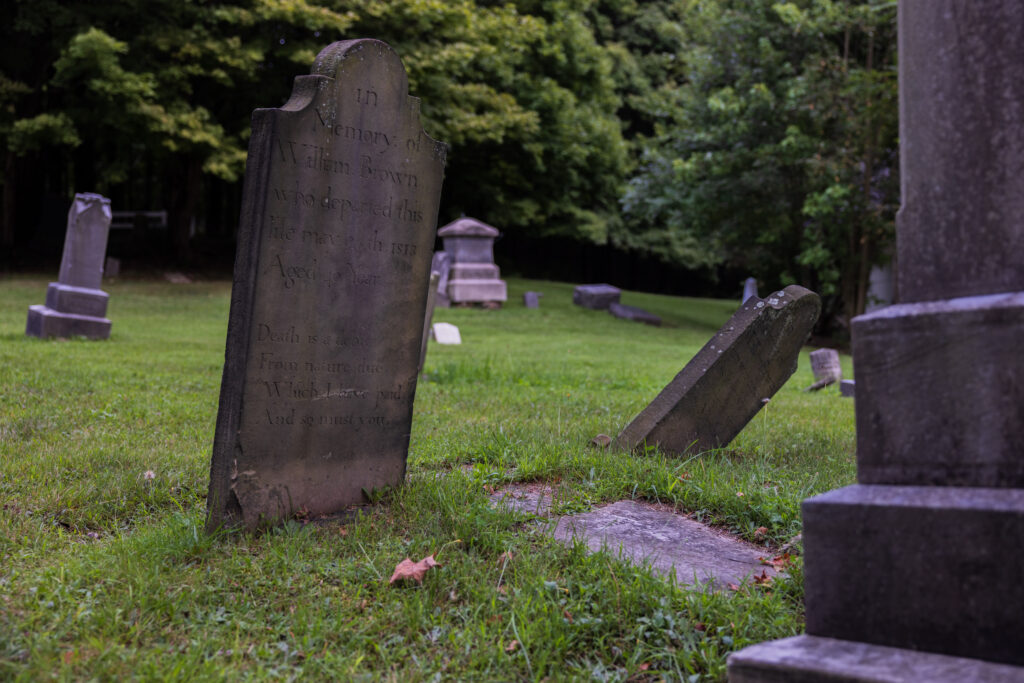
But within its half acre are stories of early settlement, migration, loss, faith, music, family, and memory. The cemetery connects Vernon Township to Connecticut, Pennsylvania, the War of 1812, the Western Reserve, gospel music, and the first generations who built lives here.
Some stones still stand. Others have disappeared.
But the stories remain.